Deploying Derby applications
Derby Developer's Guide
39
Deploying Derby applications
Typically, once you have developed a Derby application and database, you package up
the application, the Derby libraries, and the database in some means for distribution to
your users. This process is called deployment.
This section discusses issues for deploying Derby applications and databases.
Deployment issues
This section discusses deployment options and details.
Embedded deployment application overview
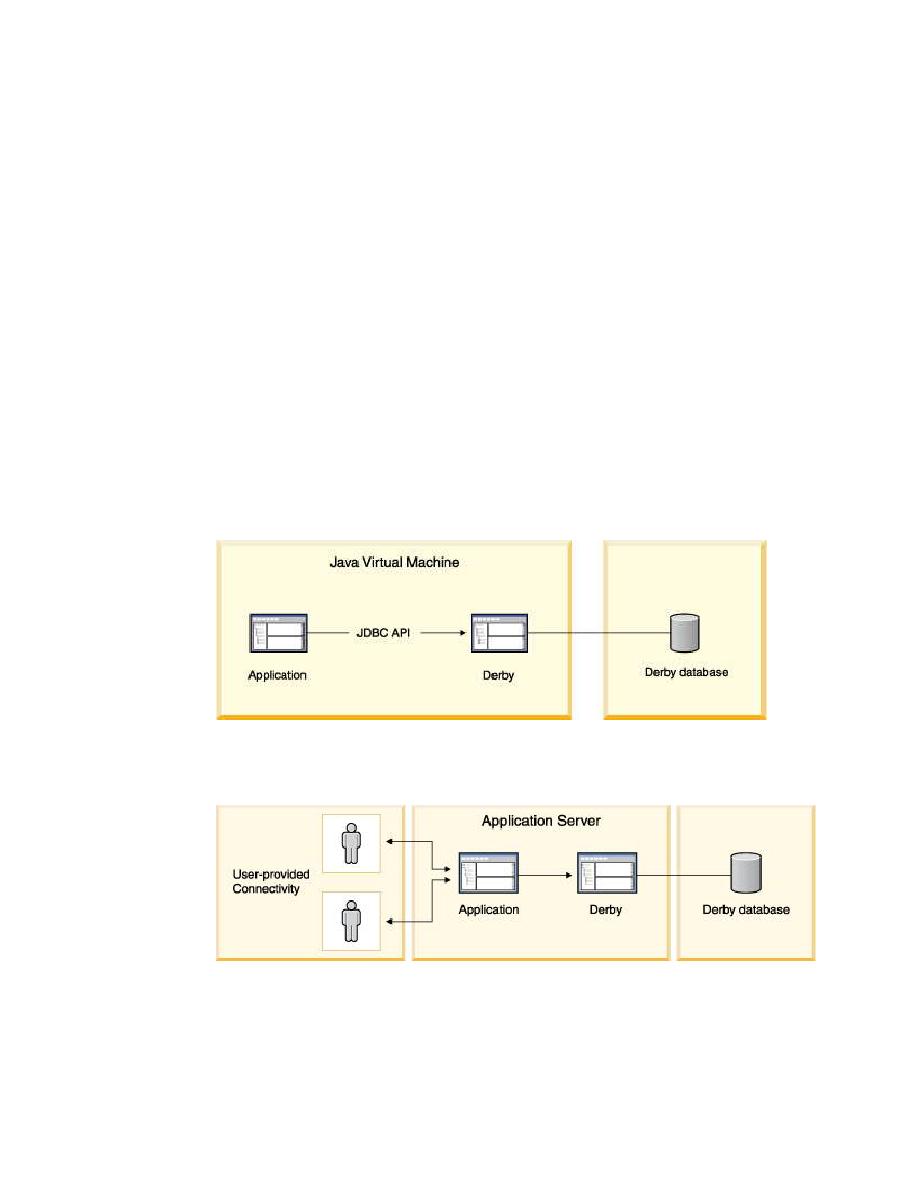
In an embedded environment, Derby runs in the same JVM as the application.
The application can be a single-user application or a multi-user application server. In the
latter case, Derby runs embedded in the user-provided server framework, and any client
applications use user-provided connectivity or allow the application server to handle all
database interaction.
The following figure shows Derby embedded in a single-user Java application.
Figure 3.
Derby embedded in a single-user Java application
The following figure shows Derby embedded in a multi-user Java application server.
Figure 4.
Derby embedded in a multi-user Java application server
When a Derby database is embedded in a Java application, the database is dedicated
to that single application. If you deploy more than one copy of the application, each
application has its own copy of the database and Derby software. A Derby server
framework can work in multi-threaded, multi-connection mode and can even connect
to more than one database at a time. A server framework, such as the Derby Network
